

Promoting Accessibility: Turning Influence into Inclusive Impact
THANK YOU FOR CALLING PODCAST: EPISODE 2
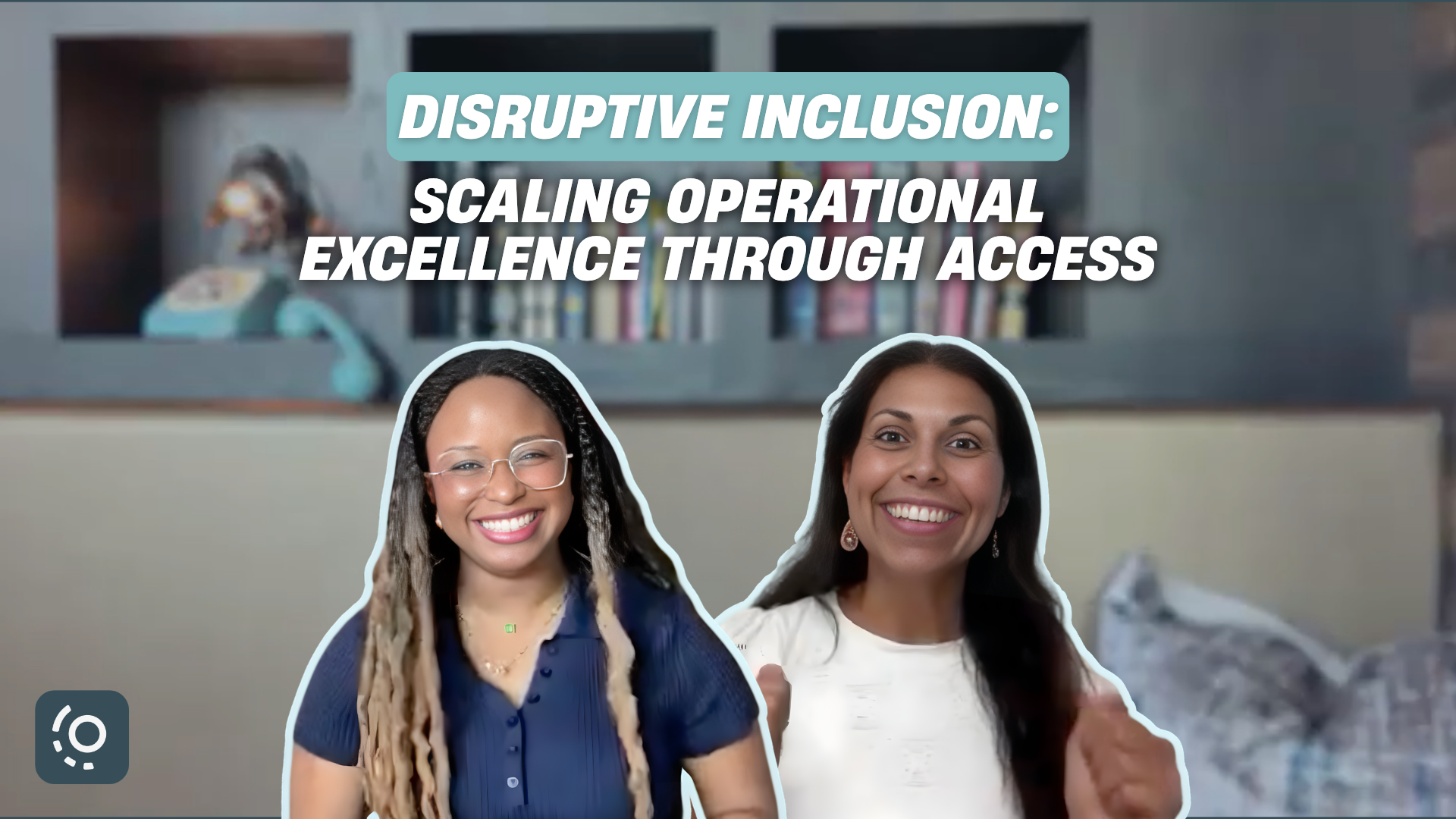
Shantel Love’s philosophy centers on "unapologetically owning your space." For a Deaf customer or employee, owning that space is impossible if the environment isn't accessible. This episode bridges Shantel’s expertise in leadership and customer success with the critical need for B2B accessibility, transforming "honest ignorance" into actionable inclusive leadership.
“Thank You for Calling” is a powerful storytelling podcast that shines a light on the Deaf experience while challenging businesses to rethink accessibility. Each episode features candid conversations with Deaf community members sharing their most jarring experiences navigating a hearing-first world, alongside hearing leaders from Fortune 500 companies who are reimagining customer service for inclusivity. Together, these voices reveal both the barriers and the breakthroughs, highlighting why direct sign language access isn’t just the right thing to do, it’s the future of customer experience. Short, powerful, and thought-provoking, this is the call every leader needs to answer.
Transcript:
Michelle: Hello, welcome to Thank You for Calling. We are joined today by Shantel Love, a powerhouse executive at Pearson, whose work sits at the vital intersection of leadership, customer success, and personal branding, which are used to drive and impact change. Today we will tackle the double barriers faced by under represented professionals and the reality that a brand built on exclusion is no legacy at all. Today's conversation is a candid conversation about shattering the B2B status quo and ensuring that every customer has the tools they need to unapologetically own their space. Shantel, welcome to the show.
Shantel: Thank you so much. It's a great great honor to be here. The work that Craig and Vanessa are doing is just amazing. So, I'm really really honored to be in this space with you all.
Michelle: Really 360, as I'm sure you've already heard from Craig, is all about improving accessibility to consumer services for many deaf folks everywhere. I myself in the past couple of weeks have been struggling with health insurance going back and forth and the fact that we have services like this provided where I don't have to wait on the phone for 2 hours anymore and I can just instantly connect with the deaf person to resolve an issue. We need that. And I think that type of service, that kind of approach will help not only my community, but everyone in general, especially now with our artificial intelligence collaborations. There are just a lot of exciting things happening with 360. One of the things that's most exciting is how this parallels what people who come from marginalized communities and what they experience in customer service, whether it could be biases, it could be lack of accessibility, or lack of understanding of what the community needs. I'm excited to talk with you because you're someone who has built your way up the ladder and have built a personal brand and I think your story will really resonate with our community.
Shantel: You know, I really appreciate the perspective that you bring as well because we think about communities and we typically think about them as a group of people that we come in proximity with and those communities look different from person to person. And when you speak specifically about marginalized communities, that's one of those communities that I can stand up and raise my hand of being a member in because being a woman, a Black woman, especially in corporate America and just a Black woman from very humble beginnings. I know what it feels like to have someone write out your destiny before you even take your first breath. And I really believe that not just conversations like this, but organizations like 360 Direct Access are very very important and critical to not just showcase that someone created the margin. We've never really been intended to be marginalized. Someone created that margin and is in so many ways reclaiming that power and showcasing the ability and willingness to be a voice to be an advocate to be that one. And sometimes it only takes one who's willing to take that step forward to say I am not going to let someone define the way that life should be. I'm going to take advantage and use my power and my authority to make life better, not just for myself, but for others. With that being said, I have found myself doing that in so many areas of life. Not just in the corporate space, but growing up on the east side of Detroit, um, and not knowing anything other than what poverty was. Sometimes you can get stuck in that mindset because everything around you looks like that. That's my first experience with the community until I stepped outside of that community and realized that there was so much more than what I believed in that small city of Detroit. So, um, yeah, definitely as an executive, as a leader, as a professional, and as an advocate, if you will, of the work that Craig and Vanessa are doing at 360 Direct Access. I think that this is a great space to be in, and there's a lot of work left to do.
Michelle: Yes, absolutely. I identify with a lot of what you recently mentioned. There's one thing I do want to focus on. You talk about being a voice for your community. How do you become a voice when the world assumes you don't have one to begin with? For example, when you can't speak or you don't speak, but sign. One of the funniest things that our community likes to talk about is that people say, "Oh, the deaf community is a silent community." But no, this is one of the loudest communities. We are a loud community. We don't hear the noise. So, we can be loud. So, that's a common misconception that I want to try to push back on. How do we define voice?
Shantel: I love this question so much and I am going to share a story. So, outside of my work at Pearson, I'm also a keynote speaker and an author of the book Promote Your Damn Self. A lot of people love hearing that title because they're like, "That's so catchy. It's amazing." Um, but it's more of a lifestyle. It's owning your brand, owning your voice, owning your purpose. And when you speak about the deaf community and it being the loudest community and people misunderstanding and not having enough education about it, it reminds me of a conversation that I had recently with my 8-year-old son, Isaiah. Now Isaiah is an eight-year-old and he's really tall and he looks like an 11-year-old and he's commonly misunderstood. He is one of those kids that absolutely loves science, everything about science, everything about space and outer space. And recently he came home and he was telling me about Artemis 2 and how it was just an amazing feat and how it was monumental and um returning humans to the moon. Yes, it's a historic achievement, but I wanted to share some insights with him as his brain is evolving. I wanted to push back a little bit and let him know about the contributions that the deaf community had on space before we even got to Artemis 2. And what I shared with him is that in the late 1950s and early 1960s, NASA needed to understand how the human body would respond to weightlessness and disorientation in space. They specifically recruited deaf men who had lost their hearing due to meningitis at the time which also affected their uh vestibular system because they weren't completely immune to motion sickness and what I told him is that these men, part of what became known as the Gallaudet 11, right? They went through some grueling training as astronauts. They rode uh these big rocket ships. They went on these zero gravity flights. They were pivotal, right, in helping NASA understand how to keep astronauts alive in space. They were never sent to space, but they were used for science. They got the sideline glory. And that is a story that I wanted my son to know, because we can celebrate Artemis 2, but we failed to celebrate the individuals who actually made it happen. And that is the story of inclusion that we don't always talk about enough. So when I hear things like Artemis 2, I think yes, celebrate it. And I also hold space for the people who built the foundation decades ago and never got their moment. And I bring that up at this moment because the deaf community never lost their voice, representation has always been there. And I think when people actually slow down and understand versus assuming and empathizing when it's not necessary, they create a space of true understanding, true advocate, true advocation, I should say, and a space where all voices, even if you can't hear audibly, are represented. And that's why I believe representation isn't just optics. It's about making sure the people who do the work are also the ones who are taking flight. Not just a flight to outer space, but if we're talking about customer service, if we're talking about well-being, if we're talking about inclusion, that's where representation of all kinds and all parties should definitely be taken into consideration because that's how we ensure that all voices are truly heard.
Michelle: Yes. Yes. For sure. You know, it's funny because Gallaudet is based in DC, which is where I am, and I've seen, they do have a museum exhibit that talks about the Gallaudet 11. Yes. And also maybe you've heard of Nyle DiMarco. Yes. So recently there was a post on his Instagram too just to help share that story as well and to put it out there. So I'm just happy to see that you spoke on that. So that's really something that's touching and it makes me think that it's just not about promoting your own damn self but also bringing people to help promote your story as well.
Shantel: I fully agree that and I think that it starts with the self like me pouring that into my son. He has the information and now it's his responsibility to choose what to do with that information. So, me, I can sit here in all of the glory that I've created for myself. But what's the good of having something that's good for the world if I'm holding it for myself? And I think if more people thought in impact versus in selfishness, we wouldn't be having conversations like this.
Michelle: Going back to your story - you’ve often been the youngest or the first, the only, in the room. When you’re in a space like that where it’s not inclusive, what does that make you feel about the company and their legacy?
Shantel: Yeah, I appreciate that. Uh, honestly, as a woman who watched my teenage mom go back to school to get a degree, to work four minimum wage jobs, to do everything right, um, only to make $20 an hour for 35 years of her life. I realized that I was becoming her story. Um, I was consumed with what I saw around me. And that story of watching my mom go through all of that was the motivation for me to catapult my career, to do the things that felt uncomfortable, do the things that looked very, very different to anyone that I grew up with or went to school with. And when you say things like labels, being the first and the youngest, it really doesn't impact or affect me because someone has to be the first, someone has to be the youngest. And I just look at it from that perspective. But when I look at it from that perspective as well, my goal is not to be the first and the only, right? And I don't want to be the last. I'm always aiming to identify where those opportunities are where someone can be the next or younger than me. Why not be younger than me or you know have the blueprint to get there faster than I got there. And as a part of that and doing that that becomes my legacy. My legacy doesn't anchor on being the first and the youngest. There will come a point in my life where I'll go on to a heavenly place and you know my family may remember me for a period of time, but what will be most remembered is what legacy I left and that's most important the legacy that I leave in corporate America uh leading teams very diverse teams that um are representatives of the types of customers that we serve not just a checkbox or a job description. Um, I see skills, I see talent, I see people before I see anything else. And, uh, when I think about legacy and when I think about what I want to leave, it's not just, uh, the good things that I did or the happy days. I think it's also important to be vulnerable to share the humble beginnings, the challenges, the things that I endured um that may not have been pleasant but sharing them from the perspective of how I was a victorious and not the victim of those circumstances. So when I think about that from that perspective, my goal is often to empower. My goal is often to think of how can I impact the next or the future generations now in a positive way. How can I set them up for success? How can I look at things longer term versus a shorter term perspective? So labels are labels. People will give you a label from a space of what they've been taught, what they know, or it could be a projection. It's the responsibility of that person to interpret that label, to receive it or to dismiss it. And we have the power to do both of those things.
Michelle: Yes. Exactly. And on that note, this relates to any company that creates an environment with labels where there are those labels that pop up continuously. That causes people to feel disconnected sometimes because representation isn't there, because we're feeling like we have to do more work just to get ahead to the next level. So when we see a company that has that kind of system or viewpoint, when they see a company with a system that isn't inclusive, what do you suggest we say to them regarding their customers feelings of disconnection, feelings of frustration, and not being represented, seen, or heard?
Shantel: I um really appreciate this and it honestly makes me think of this book that I'm reading. It's called the Four Agreements and uh the four agreements are: be immaculate with your word, don't take anything personally. Don't make assumptions, and do your best. And I'll be honest, number two is the one that I struggle with when it comes to customer service, because I take every piece of it personally. Um and you see I work at Pearson which is the world's largest learning company and the division that I work in is clinical assessments. So, we support our clients with psychological assessments and those can be anything on the spectrum from how you think. We study the mind. Uh, we support cognitive functions and I have a sister who has special needs. So, we've been utilizing these types of assessments since 1987. And I take the work that I do personally. And when I hear a customer um that's representative of a community and specifically the deaf community, if they're coming in and they're saying that they're not getting the service or they're not being heard, I'll first and foremost say that customer service often starts with the employee experience and how the employees are represented and how their voice or their recommendations are um brought to the forefront. And I remember honestly when I met Craig, I had no idea that this type of world existed. And I've worked in customer service and contact centers for over a decade. And surprisingly at the time, I had brought one of my employees with me. She was the manager of our team and she's fully deaf in her left ear and hard of hearing in her right ear and has visibility challenges in her right eye. And uh between she and I, I've understood her and made accommodations with HR, have made accommodations for her as well, as well as other members of my team, but never took the step to understand what that looks like outside of the organization that I was responsible for. And it wasn't until that interaction with Craig when I heard his story and she was there present and I can see her response without her saying a word. You can tell that she was seen and felt heard and felt represented in a way that she hadn't felt before. And she's at, you know, a point in her life where she's like 10 years from full retirement. Um, and it led me to a point where I'm like, "Hold on, wait a minute. Why haven't I heard this before?" And I started looking into our organization of 40,000 employees and asking if anyone else had these practices or anyone else heard of companies that were um leaning into the deaf and hard of hearing community and it was mute. So I immediately started taking actions to identify do my research and then to identify how we can make it better because when you mirror that situation, Michelle, it likely has happened and we were just completely unaware, oblivious to the fact that a customer could call using our relay line and we not hear anything and we're thinking, okay, no one's on the other end of the the line, but not holding long enough for an interpreter to come on the line or even a worse situation, we disconnect a call because we just don't know anyone's there. Not to excuse anything, I think that I started in a space of just lack of awareness and I know that many other I won't say that there may be other leaders other organizations that are just not aware so to go back to that the feelings would be valid and I think honestly um having dialogues like this, having spaces like this, and really uh putting a mirror uh out to the blind spots that organizations are missing is a a really good start. I don't think that it'll solve the world's problems there, but I do think that there needs to be a bigger spotlight on this space.
Michelle: Definitely. I really love what you said about having a personal experience with your employee. So you have an understanding by being in contact with deaf people from those communities. Those experiences will broaden your mind and open your eyes to new perspectives. Not everybody has that opportunity to have those aha moments. So, how can we encourage and support companies in being able to anticipate the needs of the communities they are not aware of? Because the biggest part of customer attention and loyalty is that experience. And as you mentioned, understanding that would be a challenge, including the struggles of trying to find the right partners for the right kind of support. But again, if you don't know what you don't know, how can you be able to anticipate those needs to provide a better experience for your customers?
Shantel: This is the hard one. I think if I knew the exact and precise answer, um, I would probably be the world's richest woman. But if I were to take a stab at it, um, one of the things that I will say that's helped a great deal with perception inside of company, so I'm going to do an inside out approach, um, is um, really leaning into the areas where a company has either affinity groups or employee resource groups. And what I've appreciated about the employee resource groups that uh I've been a part of, I've been an executive sponsor of several employee resource groups, specifically uh African-American and Black employee resource groups, women employee resource groups, and our able resource groups. Um I think that that's a really good area to take an inside out approach to listening, having listening sessions, understanding what's important and what's of value across the organization where employees wish that an organization would spend more time on and even their experiences. I love when I get connected to those affinity groups that support uh customers directly because you get a great deal of feedback there. Um and then I think the other side of it is just sheer intentionality. The best companies that I've worked for don't always have the answers and they find themselves hiring consultancies and consultants to make them better. And I remember experiencing consultants that would come in and share with us that we should stop, you know, more or less drinking our own juice and and really lean into the perspectives of our customers and the way that we ask questions, the types of forms that we have that really fosters that true and authentic dialogue and us doing more listening than talking. And I think just that simple part of doing more listening than talking actually supports the direction of really uncovering some of the things that we don't know about. I know as a leader of customer service, I do a lot of listening to calls and listening to customers and a lot of the decisions that I make are not necessarily my own. They're feedback that I've gotten from customers. There are these going back to the aha moments that I've gotten from customers and being open to not being the person who has to know everything and being the creator of the idea. Um, so I would say, you know, listening to customers and honestly, I know that we're, I'm picking my words carefully, but we're at a space where our nation has made some shifts with how we look at diversity, equity, and inclusion. And I think that it's not necessarily about the words diversity, equity, and inclusion, but I do believe that inclusion, equity, and diversity should be in every piece of work that you do across. You can create a synonym. So it doesn't fall into the DEI, but you can't have an organization that's representative. You cannot have an organization that's not homogeneous, right? That um doesn't focus on inclusion, equity, or diversity. And sometimes that does not sit within your organization and you may need to look outside to see what the best practices are and where are the opportunities for your organization. That's what I would recommend.
Michelle: So for those companies who are watching this, please keep this important feedback in mind. So I'm going to make this my last question for today. Part of what you mentioned was collecting customer feedback or engaging with employees internally, having a space for conversations to happen. This is still a kind of wait and see or a wait until I hear about it approach, right? Which isn't necessarily all that bad. These efforts are better than nothing being done. And I want to add leaning on your experiences in your role as a leader in customer service. We know the cost of access, they can be high. So if there was a one stop shop option available that might be used frequently or used seldomly but it's there and that shows representation like we discussed earlier. Do you feel that's something that a company should invest in?
Shantel: I know you said the cost of inclusion, but I think the cost of exclusion is even higher when you really lean into it. And one of the things that I do know for a fact is I'm not a fan of the hurry up and wait model where if something goes wrong then you're trying to retrofit it or you've received feedback from your customers and now you want to take action on it. I prefer of course the proactive approach of thinking uh two or three steps ahead or reverse engineering or decision treeing and I know my teams, we do a lot of decision trees. If this customer comes in and this doesn't work what do we do and if this does work what do we do, but I do feel that the cost of exclusion is a very high cost. The other point that I want to bring up as I recall what you were mentioning is that um what I've noticed is that sometimes people who are professionals, leaders, organizations and companies don't understand what they need until they realize the pain. And what I mean by the pain is the impact that it has on the customers, the impact that it has on the bottom line, the scope of the community that we're talking about. And fortunately and unfortunately, sometimes those situations have to be simulated. And I know for me, I would call my initial conversation that I spoke about earlier as a simulation. That was an opportunity for me to put myself in someone else's shoes. That was me taking the opportunity to say this is one person that I've met but there are 41 million other people who have been identified in the US of deaf and hard of hearing. So I do believe that a product like this is a service, a solution like this, I should say is definitely worth investing in. It's getting it to the market so that they can understand the pain and putting themselves in the shoes to understand the cost of exclusion because while I can talk about it as a heart-centered leader, it's also important to talk about it from the impact, the opportunity cost, the customer segmentation concerns, benefits or pluses and look at it holistically as an ecosystem because ignoring a certain segmentation that is growing. Um that is oftentimes a part of your current customer segmentation and it just hasn't been segmented, defined or nurtured, if you will, um can be a greater cost than um excluding it can be a greater cost than ignoring it.
Michelle: Absolutely. Absolutely. So Shantel, I want to ask if you have any last words for our viewers. Your insights today have been remarkable. Honestly, I really could watch you talk all day. So if there's anything you would like to add to the people out there watching, our viewers, we'd love to hear your final thoughts.
Shantel: Yeah, I think the thing that's settling in me right now is that we are in what we refer to as the AI era. And we find ourselves so consumed with technology and what AI can do for us. And I think that that's great. And while we're looking at investing in AI, improving our AI tools, and growing our AI acumen, I want to encourage and remind leaders that human intelligence is still number one. And when you're thinking of AI and when you're thinking of human intelligence, where is that intersection where there's a possible opportunity where there's exclusion, exclusion of human thoughts, exclusion of human emotions, exclusion of human intervention. And I really encourage you to look at it from that perspective because as we're moving so fast in this AI era, we'll get there. We'll improve more. But there's a definite opportunity to make sure that we're leaning back and slowing down before we speed up to really take a gander and look holistically at the human experience that we're still supportive of.
Michelle: 100%. Everyone, I want to thank you so much for watching today. Thank you, Shantel Love, for joining us today. And I want you to think deeply on this. Whether you're a deaf consumer, use what Shantel said about using your power to find your voice and advocate for yourselves regardless of the room you're in, even if you're the first or the last. Being there to create representation, that is key. For these companies out there, you don't know what you don't know. Lean on internal and external information to really help you connect with your customers. Avoid the wait and see mindset and that technology will solve everything. We'll always need humans in the process. Customer service is all about human centered solutions. So that's something to keep in mind. And with that I say, Thank You for Calling.
Recent Posts